


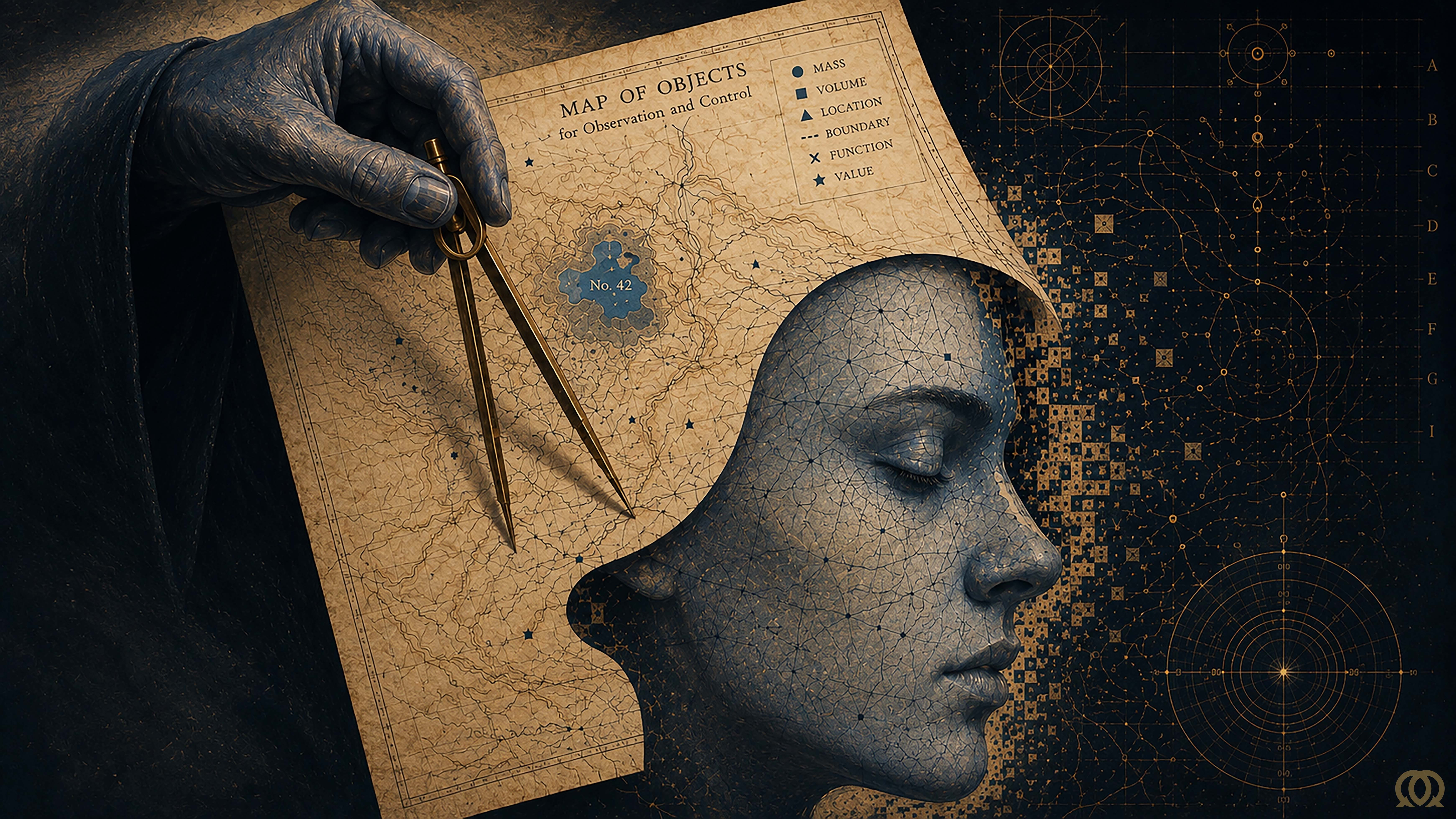
There are maps that serve beautifully within their proper domain, and those that become quietly destructive when carried beyond it.
This is not necessarily because the map was false. A false map may mislead quickly enough to be corrected. The more subtle hazard belongs to the useful map, the map that produces results so impressive that its success begins to conceal its limits. Such a map, a map that helps us cross one particular terrain, can be mistaken for one that can be applied everywhere. A method that enables mastery in one domain may be extended, almost without noticing, into another. And because it worked before, we assume that any difficulty now belongs not to the method, but to the terrain that has not been sufficiently reduced to fit it.
This is one of the great errors of the modern understanding of consciousness: the map made for objects was applied to subjects.
At first this may sound too abstract, too philosophical, too removed from the practical conditions of ordinary life. Yet it is everywhere. It appears whenever the human being is treated primarily as mechanism, system, or biological machine. It appears whenever experience is only trusted after being translated into measurable terms, and whenever consciousness is approached as though it were one more thing inside the world to be located, isolated, measured, and finally reduced to processes that can be described from the outside. In short, whenever consciousness is abstracted. The difficulty is not that objects should not be studied as objects. They absolutely should. The difficulty is that subjects are not merely objects, and this distinction is not an appeal to human specialness against the cold clarity of science. It is a matter of cartographic precision.
The subject is embodied. It has organs, hormones, nervous system patterns, electrochemical processes, metabolic states, genetic inheritance, evolutionary history, and measurable correlations. These matter. They are not illusions. Any serious account of the human being must include them. But the subject is not exhausted by them. There is something it is like to be… always.
That sentence, simple as it appears, interrupts the map designed for objects.
An object can be described from the outside. It can be weighed, measured, located, moved, scanned, predicted, disassembled, classified, modelled, and placed within causal relations. A subject may also be described in many of these ways, but the subject is not only what can be described. The subject is the field in which the description itself appears. The subject is not merely seen from the outside. The subject sees. The subject is not merely acted upon. The subject experiences. They are not only part of the world as represented, but are simultaneously the centre of encounter through which the world is disclosed. This is why consciousness becomes a problem inside the wrong cartography. If one begins with a world imagined as fundamentally object-like, and then attempts to explain how subjectivity arises within it, consciousness will appear late, strange, difficult, perhaps even embarrassing. It will seem like an anomaly that must eventually be brought under the authority of the object-map. The question will be phrased accordingly. How does matter produce mind? How does brain activity generate experience? How do neural processes give rise to the immediacy of awareness? The difficulty is real, but it is not clear that the difficulty belongs to consciousness. It may in fact belong to the map.
A map designed for objects will naturally struggle to contain subjectivity, and this should not surprise us. And yet modernity treats this struggle as though it were evidence that experience must be reducible, rather than evidence that the inherited map may be incomplete. Consciousness does not fit neatly within a third-person description, so consciousness is treated as a puzzle to be solved by more refined third-person description. Qualia resist reduction, so qualia are reinterpreted as illusion, report, function, neural pattern, representational content, or behavioural correlate. The map fails to contain the terrain, and then the excess is blamed upon the terrain.
This is not rigour; it is the defence of a cartographic posture.
The problem can be seen in the way we speak about the brain. The brain is often described as though it were the producer of consciousness in the same way a machine produces output. Certain neural states correlate with certain experiences, and from this correlation an entire metaphysical posture is then implied. The brain lights up here, therefore that. The brain integrates information, therefore awareness. The image is compelling because it gives us something visible, something measurable, something located. It allows us to look at consciousness from the outside. But the outside view is not the whole view, nowhere near in fact: no brain scan of a grieving mother is grief. No neural correlate of pain is the pain as suffered. No account of auditory processing is the shock of hearing a dead parent’s voice in a dream. The brain is necessary to the local embodiment of experience. Its activity can be measured, correlated, and studied. It may be deeply involved in the structures through which experience becomes available to description. But to describe the bodily and neural conditions through which experience appears is not the same as experience. The map has found conditions. It has not replaced the encounter.
This distinction is often lost because the object-map is so powerful. It has given us a powerful range of maps: neuroscience, pharmacology, imaging, behavioural science, and countless interventions that improve and extend life. Its power is not in question. What is in question is whether power in one register entitles the map to ontological supremacy. A microscope may reveal the cellular structure of tissue, but that does not mean the whole truth of the body is cellular. A brain scan may reveal correlations of experience, but that does not mean experience has been contained by the scan. The object-map reveals only what can be objectified. The subject is precisely that which cannot be fully objectified without remainder. And this remainder is not an inconvenience to be eliminated. It is the living centre of the matter. It is where experience occurs. It is where meaning appears, where beauty is encountered, responsibility is felt, shame burns, and death becomes more than biological cessation. The subject is not an object with decorative interiority added later. The subjective is the interior disclosure of world. To forget this is to construct a civilisation that can describe people with increasing precision while failing to encounter them.
That is, increasingly, the civilisation in which we live. We have become measurable units, symbols on a map. The worker has become an output figure. The student’s struggle becomes a point within an academic attainment matrix. The patient becomes a case file. We have become demographics, trends in consumer behaviour. The self is now a brand, and the body a dashboard interface. Each map captures something useful. Each may help in specific contexts. But when these maps accumulate and return as the dominant way a person is understood, the subject begins to recede beneath the systems that so efficiently describe them. This slow vanishing is rarely experienced as dangerous at first. Instead, it feels like efficiency, professionalism, progress, objectivity, even care. It feels like being understood through the clean authority of models, scores, categories, diagnostics, and frameworks. The line is crossed when the subject must justify their experience before the map’s authority.
When a person says, “I am in pain,” and the system says, “the tests are normal.” When a body says, “I am exhausted,” and the device says, “you are recovered.” When a participant says, “something is wrong in this process,” and the container says, “that is resistance.” When a person says, “this matters,” and the culture asks, “how is that measured?” When consciousness says, simply by being, “I am here,” and the inherited map replies, “show me where.”
There is an aggression in that question when it is asked from the wrong map. Not because evidence should never be requested, nor because claims should be exempted from scrutiny, but because some realities are distorted when forced to appear only as objects. To ask where consciousness is, as though it must occupy space in the manner of a stone, or a bridge, or a chair, may already be to misunderstand the kind of reality being considered. To ask for the location of awareness among the objects of awareness is to confuse the field with one of its contents. Thus, to seek the subject as an object is to ensure that the subject cannot be found.
This is why the Hard Problem of consciousness remains so instructive.
It is not merely a problem waiting for one more discovery. It may be the sign of a map reaching its boundary. The object-map can correlate, describe, model, and intervene. It can say much about the neural, biological, and behavioural conditions associated with experience. But when asked to explain why there is experience at all, why there is something it is like to be, it begins to strain. It produces more detail, finer correlations, more sophisticated mechanisms, but the qualitative fact remains. The terrain exceeds the map. At this point, some humility would be appropriate. But modernity, in its hubris, doubles down. If the subjective does not fit the map, perhaps the subjective is illusion; if qualia are inconvenient, then perhaps they are merely representational confusions; if interiority is difficult to measure, perhaps it is not fundamental; if meaning cannot be located, perhaps it is projected. Again and again, the map protects itself by reducing what it cannot hold.
This is the movement that Querying Qualia seeks to interrupt.
Not by denying the object-map, but by restoring it to proportion. Objects matter. Bodies matter. Brains matter. Systems matter. Behaviour matters. Material conditions matter. The error is not objecthood. The error is the attempt to explain subjectivity entirely through a map made for objects. A person is not less embodied because they are conscious. Consciousness is not less real because it cannot be handled like a thing. Experience is not less serious because it is first-person. Meaning is not unreal because it cannot be weighed.
The subject must be allowed to appear as subject.
This requires a different posture of inquiry. It requires beginning not with the assumption that consciousness must be produced by matter, but with the recognition that all accounts of matter appear within consciousness. This recognition does not settle every metaphysical question. It does not provide a complete system. It does not erase the importance of empirical investigation. But it does restore the proper sequence of attention. Before the object is known, there is knowing. Before matter is described, description appears. Before the brain is scanned, awareness is present to the scan, the interpretation, the theory, the doubt, the excitement, and the refusal.
Experience first. Explanation second.
The old map finds this difficult because it wants to begin with what can be placed outside the observer. But the observer cannot be fully placed outside experience. The attempt to remove subjectivity from knowledge is itself a subjective act. The effort to objectify consciousness occurs within consciousness. This does not invalidate objectivity; it locates it. Objectivity is a discipline within awareness, not an escape from awareness.
Once this is seen, the question changes. We no longer ask only how the subject can be reduced to objects. We can ask how objects, subjects, and the field of experience relate. We can ask what kind of map can hold measurement without erasing meaning, biology without reducing Being, neuroscience without denying qualia, technology without replacing presence, and embodiment without collapsing consciousness into mechanism. We can ask what kind of cartography is adequate to a reality in which the knower is not external to the known and participates in the field of disclosure.
This is where the Clearing becomes necessary again. The Clearing is the place where the subject is permitted to appear before being translated into object-language. It is where awareness is encountered before it is explained, where experience is allowed to stand before it is reduced to correlate, function, category, or output. Without such a Clearing, every new inquiry begins already captured by the old map, and the public importance of this cannot be overstated. Many people do not feel the failure of modernity as a philosophical problem. We feel it as fatigue, alienation, over-description, loneliness, spiritual hunger, distrust of our own bodies, frustration with systems that classify us but do not meet us, and the quiet sense that our lives can be optimised while remaining uninhabited. We do not think or say, “the object-map has been applied to subjectivity,” rather, we feel like a number, or that the system doesn’t see us. We might say the explanation may appear correct, but it does not touch what we mean. We feel something is missing, and that missing thing is not always information. More often, it is subjecthood.
To recover subjecthood is not to reject the world of objects. It is to restore relation. The subject lives in a body, among objects, within systems, through language, across duration, in relation to others. The subject is not pure interiority floating free of material condition. But neither is the subject merely the sum of observable processes. A coherent ontology must hold both: the measurable and the meaningful, the embodied and the aware, the described and the lived, the object and the subject, the map and the terrain.
This is a far more demanding task than reduction. Reduction simplifies by subordinating one pole to another. Matter explains mind. Mechanism explains meaning. Behaviour explains personhood. Data explains the body. But coherence requires relation without premature collapse. It asks us to hold complexity without immediately converting it into control and to admit that the human being is not made more real by being made more measurable. It asks us to recognise that some of the most important features of reality appear not as objects but as subjective qualities of encounter. This is why the object-map must be revised, not merely extended. One cannot solve the crisis by adding more detail to the wrong frame. More data about consciousness will not, by itself, restore the primacy of experience. More neural imaging will not, by itself, explain why beauty wounds, nor will more metrics, by themselves, return the body to trust.
The issue is not lack of mapping. It is improper cartographic authority. A map made for objects was applied to subjects, and then the subject was judged according to the map’s inability to hold it. That relation must be reversed. The map must be judged according to its ability to serve the subject, not the subject according to its ability to fit the map.
It is this reversal that is one of the first acts of ontological recovery.
It allows science to remain science without masquerading as total metaphysics. It allows measurement to remain useful without becoming sovereign, and the body to be studied without being silenced. It allows subjectivity to enter the inquiry not as a problem to be eliminated, but as the condition from which inquiry begins. And, perhaps most importantly, it allows consciousness to be investigated without being reduced in advance. This is not a retreat from rigour. It is a demand for a deeper rigour capable of examining its own inherited assumptions, that can distinguish method from ontology, admit the power of object-mapping while recognising its limits, and ask whether the question itself has been shaped by a map too narrow for the terrain. A rigour that can remain with experience before converting it into explanation.
The map made for objects gave modernity extraordinary power. But power is not the same as completeness. The subject remains. Awareness remains. Experience remains. The fact that these do not fit neatly within the inherited map may be the beginning of a new inquiry, rather than a defect to be explained away. Perhaps consciousness became a problem not because it is obscure, but because the map asked it to appear as the wrong kind of thing. Perhaps subjectivity has not been hiding. Perhaps we were looking at a map that could only recognise objects.
And perhaps the first step is not to solve consciousness from within that map, but to notice that the map itself has reached its limits.
If you have found yourself intrigued by this surface essay, you might find the deeper query even more engaging:
This resonated with me because it highlights a mistake that reaches far beyond science. Whenever we apply a framework outside the domain it was designed for, we start mistaking the map for reality. Reductionism has been extraordinarily successful for studying objects, but consciousness may require an entirely different mode of knowing—one that complements analysis rather than rejects it. Perhaps the next step isn't abandoning the scientific method, but expanding our epistemology to include first-person experience as a legitimate source of knowledge alongside third-person observation.
You've put your finger on the exact violence of the error: "the map made for objects was applied to subjects." When the object-map flattens the subject, it takes a living trajectory through stratified semantic space and projects it onto a single, measurable axis. The remainder you speak of, the grief, the shock of the dream, the wound of beauty, isn't an anomaly to be eliminated. It's the topology of the trajectory itself, the high-dimensional shape that refuses to collapse into a coordinate. "Experience first" is a recognition that the map is merely the shadow of the trajectory. You are clearing the space for the actual shape of the thing.
— Iman and Darja